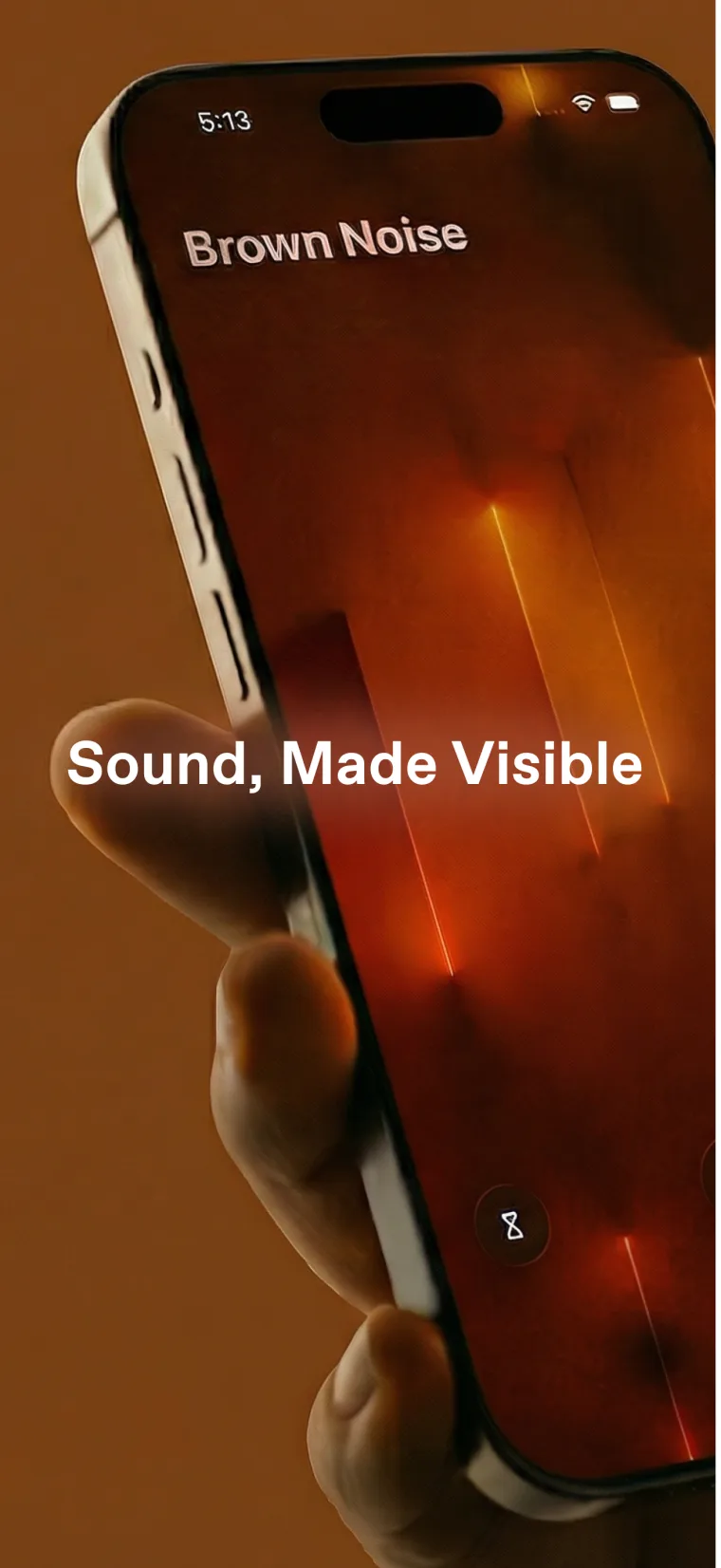
LightNoise began as a simple question: what happens if a noise machine is not only heard, but seen?
The public version is an iOS app that generates eight colors of procedural noise without samples or audible loops. Each sound is paired with a responsive visual field built from real-time rendering techniques: gradients, radiance-cascade experiments, stippling, tonemapping, and slow color motion. The interface is intentionally sparse. It is not trying to become a wellness dashboard. It is a small atmosphere you can turn on.
The larger project is moving toward a physical object: a kinetic light sculpture that produces analog broadband noise while displaying volumetric or spinning fields of color. That branch is still under development, but it gives the app its more interesting pressure. LightNoise is not only software. It is a study for a room-scale machine where airflow, display, and sound are one coupled system.
System
- Procedural audio engine with white, pink, brown, green, grey, blue, violet, and deep brown noise.
- LUFS-calibrated volume compensation so different noise colors feel balanced.
- Metal-based responsive visual engine with generative light fields and noise texture.
- Background playback, sleep timer, focus timer, widget, and gesture-based color switching.
- Physical research branch exploring spinning displays, volumetric light, and air-generated noise.
Why It Matters
Most noise machines hide the mechanism. LightNoise does the opposite: it lets the signal become visible. The work sits between utility and instrument, between a calming app and a study for a physical media object. The useful part matters, but the real subject is how a technical system can become atmospheric without becoming sentimental.